Visual Illusions in Portion Judgment
How optical illusions and container properties influence portion perception
Visual Perception of Portion Size
Visual perception plays a central role in how individuals evaluate portion size. The human visual system processes information about food quantity through multiple mechanisms, including assessment of food volume, estimation of surface area coverage, and evaluation of container dimensions.
However, visual perception is not a perfect mirror of physical reality. Optical illusions and visual processing biases can substantially distort judgment about portion size and quantity. Understanding these visual phenomena provides insight into how external perceptual factors influence portion appropriateness judgments.
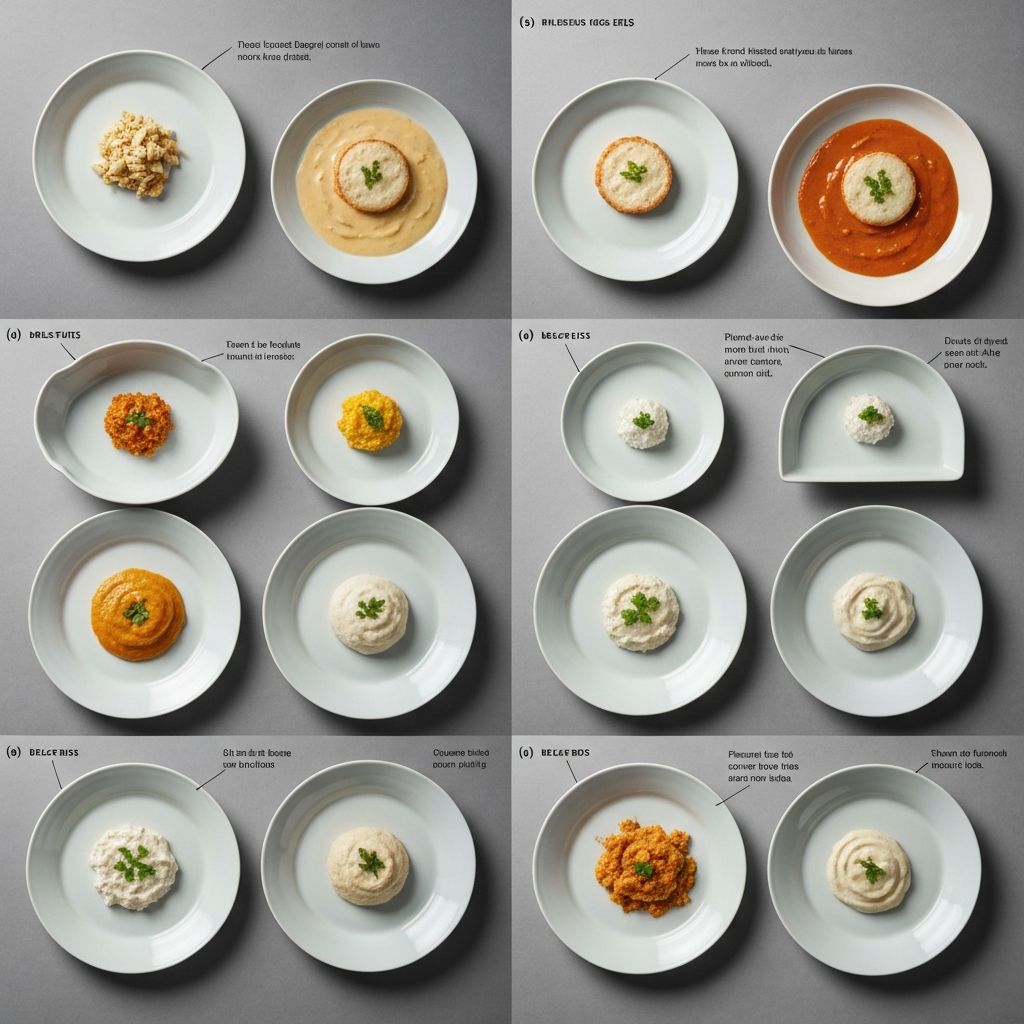
The Delboeuf Illusion and Plate Size
The Delboeuf illusion, a well-documented optical illusion, demonstrates that a circle appears larger when surrounded by a larger outer circle compared to when surrounded by a smaller outer circle, even when the inner circle's size remains constant. This illusion applies to portion perception: the same quantity of food appears larger on a smaller plate and smaller on a larger plate.
Research demonstrates that individuals perceive portions differently depending on plate size and the ratio of food coverage to plate area. This illusion operates automatically at a perceptual level, influencing how much food individuals judge to be present even when objective quantity is held constant.
Container Shape and Perceived Volume
Container shape substantially influences perceived volume and portion size judgment. The same volume of liquid appears different in tall, narrow containers compared to short, wide containers due to how the visual system processes height and width information.
Similarly, the shape of eating vessels (bowls, plates, cups) influences how the visual system estimates food quantity. Foods arranged in tall bowls appear more substantial than equivalent quantities in shallow bowls. These shape-dependent illusions influence not only how much food people estimate they are consuming but also their actual consumption behavior.
Color and Contrast Effects
The color of food and serving containers influences portion perception through contrast effects and visual processing. High-contrast presentations (such as light-colored food on a dark plate) can create illusions of increased quantity compared to low-contrast presentations (such as light-colored food on a light plate).
These color and contrast effects operate at an automatic perceptual level, influencing how individuals visually evaluate portion quantity before conscious deliberation. Food color also carries semantic information (such as associations with freshness or healthfulness) that can influence portion evaluation beyond pure visual estimation.
The Illusion of Divisibility
Foods that are visually divided or segmented into discrete components appear more substantial than equivalent quantities presented as continuous masses. This visual segmentation illusion influences how people perceive portion appropriateness and impacts their consumption patterns.
For example, a portion of food divided into four visible sections appears larger than the same quantity presented as a continuous serving. This divisibility illusion reflects how the visual system processes food structure and organization, with segmented presentations creating impressions of greater abundance.
Height and Spread Effects
The spatial arrangement of food influences portion perception through height and spread effects. Foods arranged vertically (in taller arrangements) appear more abundant than foods spread horizontally (in flatter arrangements), even when the total volume remains identical.
These height and spread effects influence both how individuals perceive portions and their actual consumption behavior. Restaurant plating practices that create height in dish presentations may influence customer perceptions of portion generosity through these visual effects.
Density and Visual Crowding
The visual density of food (how crowded or packed the food appears) influences portion perception. Densely packed food appears more substantial than loosely arranged food containing identical amounts. This visual crowding effect reflects how the visual system integrates information about area coverage and concentration.
Food preparation and plating techniques that affect visual density therefore influence perception of portion size. These presentation effects operate at a perceptual level prior to consumption, shaping how individuals initially evaluate portions before eating begins.
Individual Differences in Visual Illusion Susceptibility
While optical illusions operate at a basic perceptual level affecting most individuals, some variation exists in susceptibility to specific visual illusions. Factors including age, visual processing abilities, attention to food presentation, and prior experience can influence how strongly individuals experience visual portion illusions.
Additionally, factors such as eating context, hunger state, and attentional focus influence whether individuals rely on visual perception or other cues when making portion judgments. The relative weighting of visual versus other information varies across individuals and situations.
Implications of Visual Illusions for Portion Perception
The existence of visual illusions in portion judgment demonstrates that portion perception is not simply objective measurement of food quantity but rather reflects how the visual system processes and interprets spatial information. These illusions operate at a fundamental perceptual level, influencing how people evaluate portions even when they are aware of the illusions.
Understanding visual effects on portion perception illustrates the complexity of how people evaluate food quantities and the multiple factors beyond actual quantity that influence portion judgment and consumption patterns.
Beyond Visual Illusions
While visual illusions provide clear demonstrations of how perception diverges from physical reality, additional factors beyond visual illusions also influence portion perception. Cognitive expectations, prior experience, context, and numerous other factors combine with visual information to shape overall portion judgments.
This information is presented for educational understanding of portion science. Individual food choices and consumption patterns reflect complex interactions between perceptual, cognitive, physiological, and situational factors. Individual applications of this research vary widely based on personal circumstances and contexts.
Back to Articles